Diamond brilliance is not accidental. It is the result of carefully balanced proportions that determine how light enters, reflects within and exits a diamond. While many buyers focus on labels such as “Excellent cut,” the true drivers of light performance lie deeper in the geometry of the stone. Crown angles, pavilion angles, table size and overall depth work together as a system. When these elements are in harmony, light is returned efficiently to the eye, producing brightness, fire, and contrast. When they are not, even a high-grade diamond can appear dull or lifeless, a reality that sits at the core of Clarkfield’s diamond cut research.
This article is designed to move beyond simplified cut grades and into true proportions mastery. By understanding how specific angles and measurements influence light behavior, it becomes possible to evaluate diamonds with far greater precision. We will examine how small changes in crown or pavilion angle can dramatically alter performance, why certain combinations consistently outperform others, and how proportion ranges interact rather than exist in isolation. The goal is not to memorize numbers, but to understand the optical logic behind them so that cut quality can be assessed confidently and consistently.
What Diamond Proportions Really Mean
Diamond proportions describe the precise geometric relationships between a diamond’s facets, angles, and measurements. Rather than focusing on surface finish or visual neatness, proportions govern how the diamond functions as an optical system. They define how the crown, pavilion, table and total depth work together to control light entry, reflection and return. This is why two diamonds with identical carat weight and the same laboratory cut grade can perform very differently once viewed outside of controlled grading conditions.
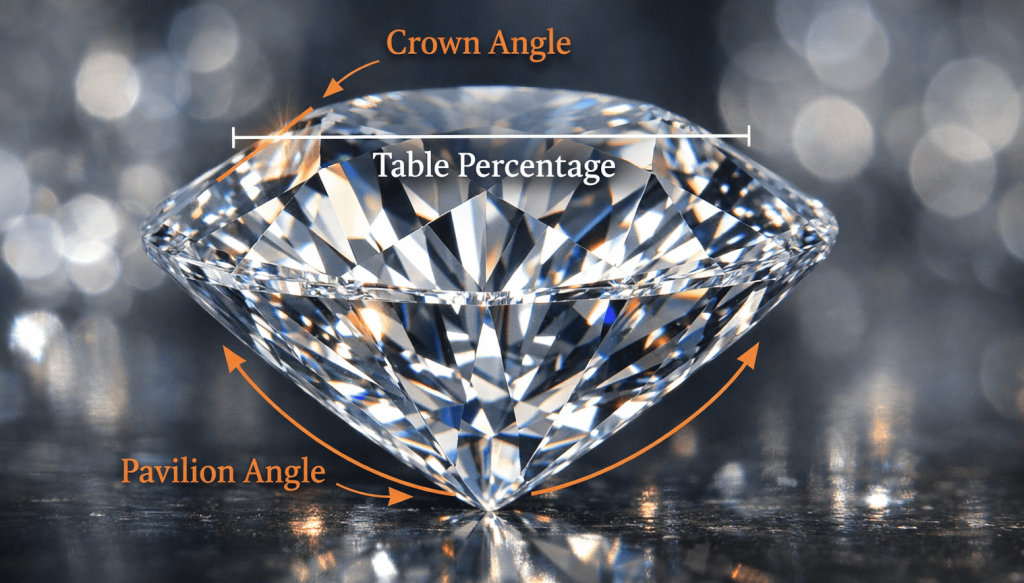
At the core of diamond proportions are angles, not finishing details. The crown angle determines how light bends as it enters the diamond, while the pavilion angle decides whether that light is redirected back toward the viewer or lost through the bottom. The table percentage influences brightness and fire by regulating light entry and dispersion. These proportional relationships are fundamentally different from polish and symmetry. Polish refers to the smoothness of facet surfaces, while symmetry describes how precisely facets align with one another. As outlined in GIA’s perspective on diamond symmetry, symmetry primarily affects visual balance and patterning, but it does not override poorly chosen proportions.
Understanding proportions means recognizing that light performance is established by geometry first. A diamond can display excellent polish and symmetry yet still appear flat if its proportions cause light leakage or obstruction. Conversely, a stone with minor symmetry variations can still look vibrant if its angles are well balanced. Small proportional changes matter greatly. A shift of just a few tenths of a degree in pavilion angle can significantly alter brightness, while slight crown angle mismatches can weaken fire or contrast. Proportions therefore form the foundation of cut quality, with polish and symmetry acting as refinements rather than the primary drivers of brilliance.
The Three Core Angles That Control Light
When evaluating diamond cut quality from a technical standpoint, three measurements consistently determine how effectively a diamond handles light. These are the crown angle, the pavilion angle and the table percentage. Together, they form the structural framework that governs brightness, fire and contrast. While laboratories assign overall cut grades, these three parameters reveal why a diamond performs the way it does.
Crown Angle
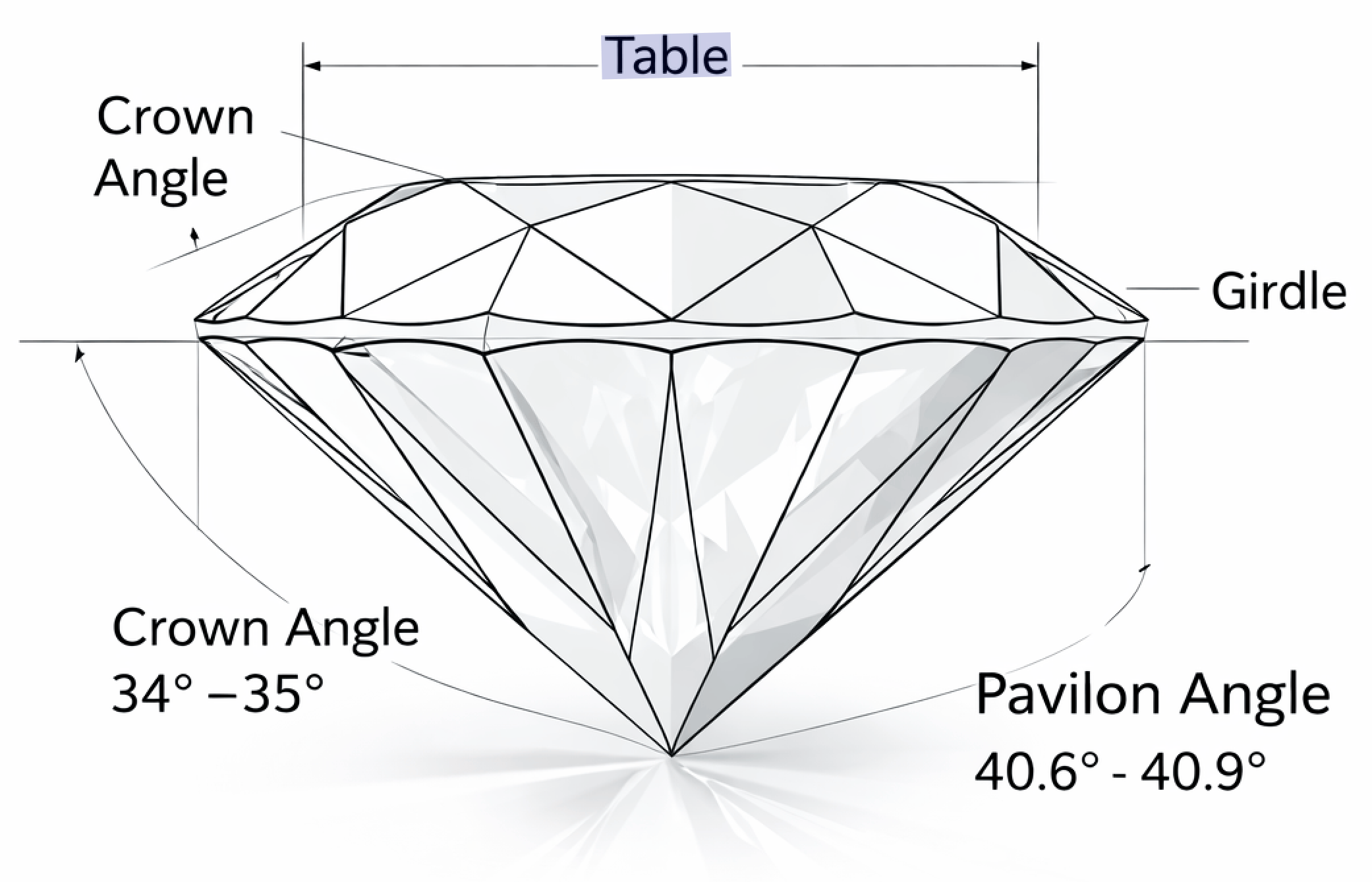
The crown angle refers to the angle formed between the bezel facets and the girdle plane. Its primary role is to control how incoming light bends as it enters the diamond. A well balanced crown angle allows light to refract efficiently, creating both brightness and spectral fire. When the crown angle is too shallow, light enters too directly and dispersion is reduced, resulting in a flatter appearance. When the crown angle is too steep, light can refract at inefficient angles, weakening brightness and causing obstruction related darkening.
In modern round brilliant diamonds, crown angles around 34 to 35 degrees tend to produce the most balanced results. This range allows enough height for fire while maintaining strong white light return. Slight deviations can still perform well depending on pavilion angle pairing, but extreme crown angles usually require compensation elsewhere to avoid visible performance loss.
Pavilion Angle
The pavilion angle is the most critical measurement for light return. It determines whether light entering the diamond is reflected back to the viewer or escapes through the bottom of the stone. Even small changes in pavilion angle can have an outsized impact on brightness. A pavilion that is too shallow allows light to leak through the pavilion facets, while a pavilion that is too steep causes light to reflect internally at inefficient paths and exit through the sides.
Optimal pavilion angles generally fall within a narrow window, often cited between approximately 40.6 and 40.9 degrees for round brilliants. This range creates the internal reflection angles needed for strong return and contrast. Stones outside this range may still receive an Excellent cut grade, but often show reduced performance when viewed under varied lighting conditions.
Table Percentage
The table percentage measures the width of the table facet relative to the overall diameter of the diamond. It influences how much light enters the stone and how that light is distributed between brightness and fire. Larger tables tend to increase brightness but can reduce dispersion, while smaller tables enhance fire at the expense of overall brightness.
Most well proportioned round brilliants feature table percentages between 54 and 58 percent. Within this range, the table supports a balanced interaction between crown and pavilion angles. Tables that are too large or too small often force compromises elsewhere in the diamond’s geometry, making it harder to achieve consistent light performance across different environments.
The Ideal Proportion Zone or Balanced Light Return
Diamond light performance does not depend on a single ideal number but on a narrow zone where multiple proportions work together in balance. When crown angle, pavilion angle, table size and total depth fall within this zone, light enters the diamond efficiently, reflects internally with minimal leakage, and returns to the viewer’s eye with strong brightness and contrast. Outside of this zone, even small deviations can cause light to escape through the pavilion or crown, reducing overall visual appeal. This is why experienced graders focus on proportion relationships rather than isolated measurements.
The Ideal Diamond Cut Proportion Zone table below establishes this gold standard by showing proven combinations that consistently produce balanced light return. These ranges are not theoretical ideals but practical combinations observed in well-performing diamonds across many grading environments. By examining the table, it becomes easier to understand why certain diamonds outperform others even when they share the same cut grade on a certificate. The table serves as a visual reference point for how proportion harmony translates directly into real-world brilliance.
| Crown angle | Pavilion angle | Table percentage | Total depth | Visual outcome |
|---|---|---|---|---|
| 34.0° | 40.8° | 55–57% | 61.5–62.3% | Balanced brightness, strong contrast, clean edge to edge light return |
| 34.5° | 40.8° | 54–57% | 61.8–62.6% | Classic top performer, crisp arrows pattern potential, reliable fire and brilliance |
| 35.0° | 40.8° | 54–56% | 62.2–62.9% | Slightly more fire, still bright, excellent contrast when symmetry is strong |
| 34.0° | 40.6° | 55–58% | 61.2–62.0% | Bright and lively, very efficient light return, slightly less fire than steeper crowns |
| 34.5° | 40.6° | 55–57% | 61.4–62.2% | High brightness with balanced fire, forgiving combo that still looks premium in most lighting |
| 35.0° | 40.6° | 54–56% | 61.8–62.6% | Fire forward look with good brightness, best when table stays modest and symmetry is clean |
| 33.5° | 40.8° | 56–58% | 60.9–61.8% | Very bright face up look, slightly less fire, can look crisp and modern when well aligned |
| 34.0° | 40.9° | 54–56% | 61.8–62.7% | Strong contrast and punch, needs good symmetry to avoid minor leakage at the edges |
What matters most is not memorizing exact numbers, but recognizing how these measurements interact as a system. A slightly steeper crown may still perform beautifully when paired with a precise pavilion angle and controlled table size. Likewise, a shallower crown can remain viable if other proportions compensate correctly. The ideal proportion zone represents this narrow window where balance is maintained, allowing the diamond to deliver brightness, fire, and contrast without sacrificing one for the other.
How Crown and Pavilion Angles Work Together
Crown and pavilion angles cannot be evaluated in isolation because they form a single optical system. The pavilion angle determines how light is reflected inside the diamond, while the crown angle controls how that returned light is dispersed and released to the eye. When these two angles are properly matched, light enters the stone, reflects internally, and exits in a controlled and efficient way. If either angle is off balance, light can escape through the bottom or leak through the sides, reducing brilliance even if the other measurements appear favorable.
This is why changes to one angle almost always require compensation in the other. A slightly steeper crown angle, for example, increases fire by bending light more aggressively, but it also demands a pavilion angle that keeps light confined long enough for that dispersion to occur. If the pavilion is too shallow in that scenario, light escapes before the crown can do its job. Likewise, a shallower crown may look bright on its own, but without a properly aligned pavilion angle, the diamond can appear flat or glassy rather than lively.
Many combinations that look acceptable on paper fail visually because they ignore this interaction. A crown angle and pavilion angle might each fall within broad acceptable ranges, yet still produce leakage when paired together. This is one of the reasons simplified grading labels can be misleading. Without understanding how these angles interact, it is easy to assume that two individually acceptable numbers will automatically work together, which is often not the case.
The Ideal Diamond Cut Proportion Zone table highlights combinations where crown and pavilion angles have already been proven to work in harmony. These pairings reflect real-world performance rather than theoretical tolerance. By evaluating angles as a matched set instead of standalone values, it becomes possible to predict brightness, fire, and contrast with far greater accuracy and avoid combinations that technically qualify but visually disappoint.
When Proportions Start to Break Down
When diamond proportions move outside balanced ranges, light behavior becomes increasingly unstable. Small deviations may not immediately destroy brilliance, but they often introduce subtle leakage that dulls contrast and reduces sparkle. A pavilion angle that creeps too shallow allows light to escape through the bottom of the stone, while one that becomes too steep sends light sideways instead of back to the eye. In both cases, the diamond may still appear bright under strong lighting but loses life in normal viewing conditions.
| Crown angle | Pavilion angle | Table | Primary issue | Visual consequence |
|---|---|---|---|---|
| 32.5° | 41.2° | 58% | Light leakage | Reduced brightness with dark center areas |
| 35.5° | 41.3° | 55% | Over-deep pairing | Smaller face-up size and heavy contrast pattern |
| 33.0° | 40.4° | 60% | Shallow crown imbalance | Flat appearance with muted fire |
| 36.0° | 40.6° | 54% | Excessive crown height | Loss of brightness despite strong contrast |
| 34.0° | 41.4° | 57% | Steep pavilion leakage | Dark ring under the table and diminished sparkle |
| 32.0° | 40.6° | 62% | Oversized table | Bright but glassy look with poor fire |
Breakdown often accelerates when multiple proportions drift at once. A slightly oversized table combined with a shallow crown can strip a diamond of fire, producing a bright but flat appearance. Conversely, a steep crown paired with excessive depth may trap light too long, creating darkness under the table and reducing overall spread. These issues compound each other, which is why diamonds that technically meet broad grading standards can still look underwhelming in real-world settings.
The most problematic proportion breakdowns are those that hide behind acceptable labels. A diamond may receive a top cut grade while still exhibiting noticeable leakage or imbalance because grading systems allow wide tolerance ranges. Once proportions move far enough from proven combinations, optical performance becomes unpredictable. This is why understanding proportion relationships matters more than relying on individual measurements or category labels alone.
Why Small Angle Changes Have Big Visual Effects
Small changes in diamond angles can have an outsized impact on how light behaves inside the stone. A shift of just two tenths of a degree in pavilion angle can determine whether light is returned cleanly to the viewer or lost through the bottom of the diamond. Because internal reflections rely on precise critical angles, even minimal deviations can alter the path of light dramatically. This sensitivity is exactly why GIA refers to cut as the wow factor, since cut quality has the most immediate and visible influence on a diamond’s appearance:

Crown angles are equally sensitive. A crown that is slightly too shallow may increase white brightness but reduce fire, while a slightly steeper crown can enhance dispersion at the cost of overall light return if not properly balanced. These small adjustments affect how light bends as it enters and exits the diamond, influencing not just sparkle but also how crisp and lively the facet pattern appears. This explains why two diamonds with nearly identical numbers on a grading report can look noticeably different in real life.
The reason these small changes matter so much is that diamond optics operate within narrow efficiency windows. Light performance does not decline gradually as angles drift. Instead, it often reaches tipping points where performance drops quickly. Once a critical threshold is crossed, light leakage increases sharply or contrast collapses. This is why precision matters and why experienced evaluators focus on fine angle relationships rather than broad proportion ranges when assessing true cut quality.
GIA Excellent Cut and Why It Covers a Wide Range
The GIA Excellent cut grade is often interpreted by buyers as a guarantee of top-tier light performance, but in practice it represents a broad approval range rather than a narrow ideal. GIA intentionally designed the Excellent category to account for natural variation in cutting styles, diamond shapes and manufacturing tolerances. As a result, diamonds with noticeably different proportions and visual personalities can all receive the same Excellent cut grade on a grading report.
Within the Excellent category, crown angles, pavilion angles, table sizes and total depth can vary meaningfully while still meeting GIA’s thresholds for brightness, fire and scintillation. Some of these combinations fall squarely within what many professionals would consider ideal, while others sit closer to the edge of acceptable performance. This explains why two GIA Excellent diamonds can look dramatically different side by side, even when color and clarity are similar.
This is not a flaw in GIA’s system, but rather a reflection of its role as a grading authority rather than a performance optimizer. GIA evaluates whether a diamond meets minimum standards for excellent light behavior across a wide range of viewing conditions. However, identifying the strongest performers within that range requires deeper analysis of proportions, angles, and how those measurements interact. This is where proportion-based evaluation moves beyond labels and into true cut mastery.
Bringing Diamond Proportion Knowledge Together
Understanding diamond proportions is ultimately about seeing beyond surface-level grades and learning how light actually behaves inside a stone. Crown angle, pavilion angle, table size and total depth are not independent numbers, but interconnected variables that shape brilliance, fire, and contrast. When these elements fall into a balanced proportion zone, light is returned efficiently to the eye, creating the visual impact most people instinctively recognize as beauty. If you ever find yourself unsure when comparing different diamonds or weighing multiple proportion combinations, feel free to reach out to us. We are always happy to help you evaluate the details and decide which option offers the strongest visual performance for your needs.
What becomes clear through proportion analysis is that small numerical differences can separate an average-looking diamond from an exceptional one. Two diamonds with the same GIA Excellent cut grade may perform very differently depending on how their angles interact. By evaluating proportions as a system rather than relying on a single label, it becomes possible to predict visual performance with far greater confidence and consistency.
This approach does not require memorizing endless measurements, but it does reward understanding the logic behind them. Once the relationships between angles and light are clear, diamond cut quality becomes easier to evaluate, compare, and explain. Proportions transform cut from a vague concept into a measurable framework, allowing informed decisions that prioritize real-world beauty over simplified classifications.