Diamond cut plays a central role in how a diamond appears to the human eye, influencing brightness, contrast, and overall visual balance. At the Clarkfield Minnesota Diamond Cut Learning Center, we focus on understanding how proportions, crown angles, pavilion angles and symmetry work together to shape light performance. Rather than viewing cut as a single grade or label, we approach it as a system of measurable factors that can be studied, compared, and understood. This page serves as an educational starting point for anyone seeking a clearer perspective on diamond cut quality and how it applies in real world buying decisions.
Understanding Diamond Cut Quality
Diamond cut quality is often misunderstood because it is not a single measurement but the result of how multiple factors work together. Proportions, symmetry and facet alignment determine how efficiently light enters the diamond, reflects internally and returns to the viewer’s eye. Even small deviations in angles can change the visual outcome dramatically. Two diamonds with the same carat weight and color can look noticeably different simply because their cuts manage light differently.
Gary Roskin, a long standing educator and representative of the Accredited Gemologists Association, has frequently emphasized that cut quality should be evaluated as a performance system rather than a checklist. In educational discussions, he has pointed out that relying solely on labels such as excellent or ideal can oversimplify a complex optical structure. What matters more is how crown height, pavilion depth and table size interact to produce brightness, contrast and fire under normal viewing conditions.
A well cut diamond balances these elements so that light does not leak through the pavilion or escape at inefficient angles. When proportions are aligned correctly, light reflects internally multiple times before returning through the crown, creating a lively appearance. Poorly balanced cuts may still appear bright under strong lighting but often lose contrast and depth when viewed in everyday environments. This distinction becomes especially important when comparing diamonds side by side.
Understanding diamond cut quality therefore requires looking beyond surface grades and learning how geometry affects optics. Educational institutions and gemological organizations consistently stress that cut quality is the most visually influential factor among the diamond characteristics. By studying proportions and light behavior rather than relying on marketing terms, buyers and researchers alike gain a clearer understanding of why certain diamonds consistently appear more brilliant and balanced than others.
Preferred Diamond Cut Proportions for Maximum Light Return
Diamond cut quality is primarily about how well a diamond manages light. When light enters a diamond, it should reflect internally and return to the viewer’s eye rather than leaking out through the sides or bottom. This behavior is controlled by a precise relationship between crown height, pavilion depth and overall symmetry. Even small deviations can significantly change how bright or dull a diamond appears in real life.
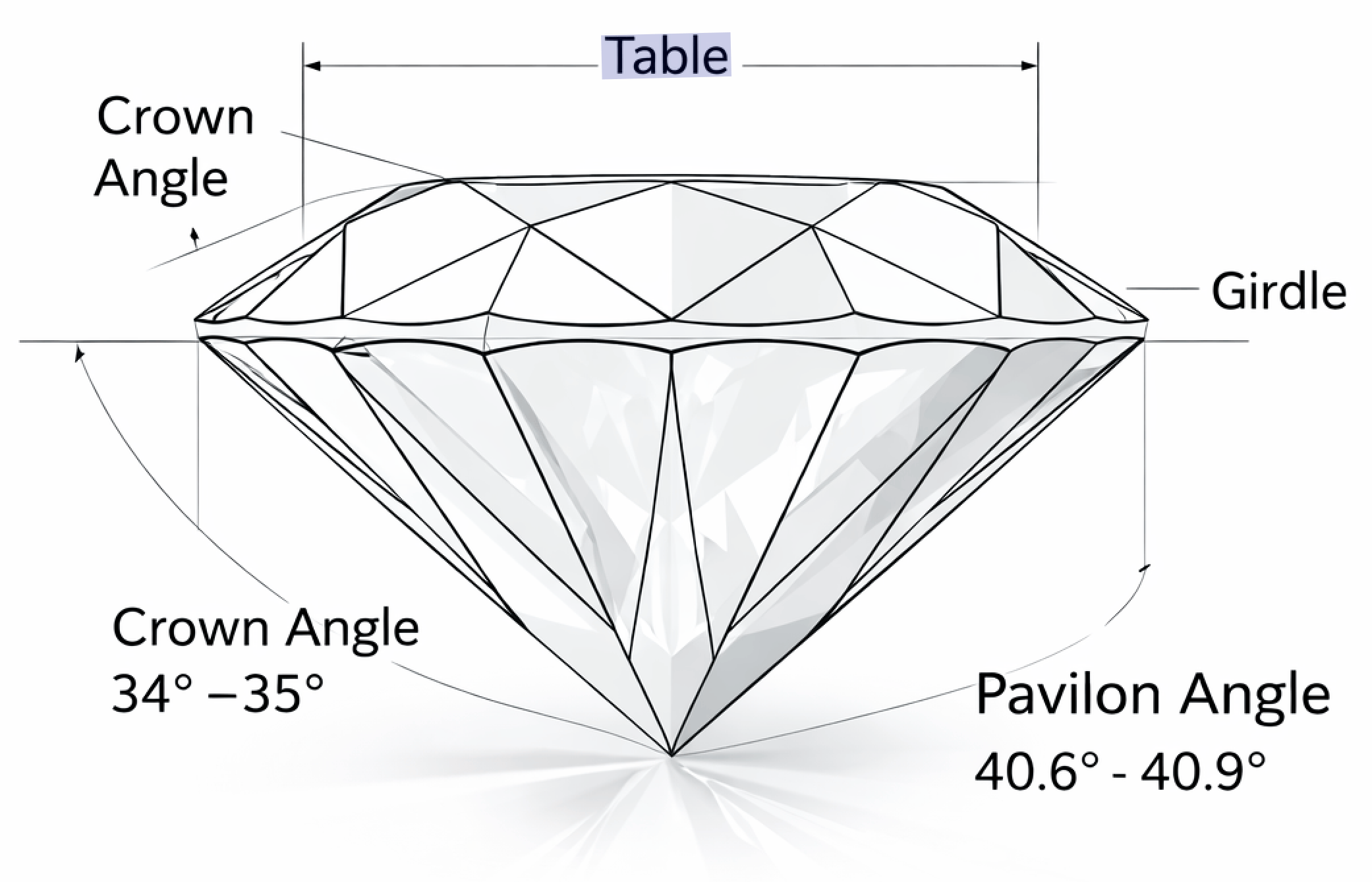
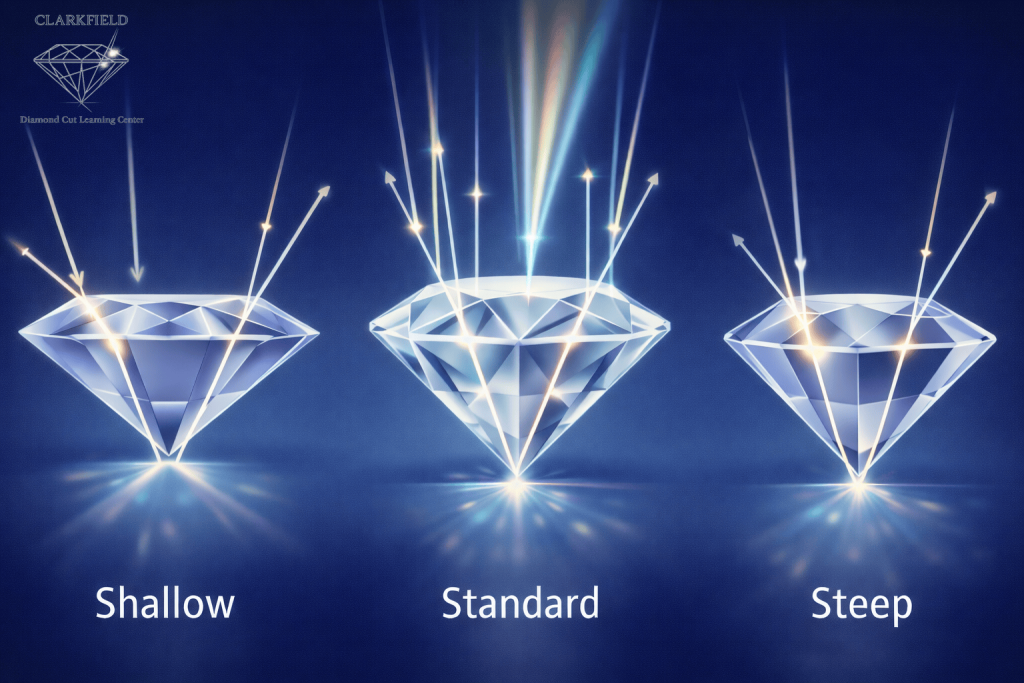
Among all cut parameters, pavilion angle has the strongest influence on light return. If the pavilion is too shallow, light escapes through the bottom. If it is too steep, light leaks through the sides. Crown angle then works together with the pavilion to shape dispersion and contrast. This is why cut quality cannot be judged by a single number but must always be evaluated as a system of proportions working together.
| Cut Parameter | Preferred Range | Why It Matters |
|---|---|---|
| Crown Angle | 34.0°–35.0° | Controls how light bends and disperses into fire and brilliance |
| Pavilion Angle | 40.6°–40.9° | Determines internal reflection and prevents light leakage |
| Table Percentage | 54%–58% | Balances brightness with contrast and face-up appearance |
| Total Depth | 60%–62.5% | Affects overall light efficiency and visual spread |
| Lower Girdle Length | 75%–80% | Influences scintillation pattern and sparkle character |
| Star Facet Length | 45%–55% | Shapes contrast pattern and perceived sharpness |
The table above shows preferred diamond cut proportions that are widely recognized for producing balanced brightness, contrast, and fire. These ranges are not arbitrary. They are derived from optical modeling, empirical observation, and decades of grading experience. For readers who want to understand why specific angle combinations consistently outperform others, our diamond proportions mastery article breaks down how crown angle, pavilion angle, table size and depth interact to control light behavior in real-world viewing conditions.
You may notice that pavilion angle is sometimes listed as 40.6°-40.9°, while other sources extend the upper limit to 41.0°. In practice, both can be correct. Pavilion angles near 41.0° can still perform very well when paired with a slightly lower crown angle and appropriate table size. However, as the pavilion approaches or exceeds 41.0°, the margin for error becomes smaller. This is why narrower ranges like 40.6°-40.9° are often recommended for maximum consistency rather than absolute possibility.
This nuance helps explain why the GIA Excellent cut grade can be misleading if taken at face value. While Excellent sounds definitive, the category actually covers a wide spectrum of proportions. Two diamonds with the same Excellent grade can look noticeably different in person. One may sit near the optimal center of the proportion ranges, while another falls closer to the edges of what is still technically acceptable. Understanding the underlying angles and proportions allows buyers to look beyond the label and focus on real light performance.
At Clarkfield Diamond Cut Learning Center, we view cut grading as a starting point rather than a final answer. Proportion analysis provides the clarity needed to understand why some diamonds within the same grade appear more vibrant, more lively and more visually engaging than others.
How Diamond Cut Affects Brilliance, Fire and Contrast
Diamond cut determines how effectively a diamond interacts with light, which directly shapes its brilliance, fire, and contrast. Brilliance refers to the return of white light to the viewer’s eye and is primarily controlled by pavilion angle and overall depth. When a diamond is proportioned correctly, light reflects internally and exits through the crown rather than leaking through the pavilion, creating a bright and lively appearance even under low light conditions.
Fire describes the flashes of spectral color that appear as a diamond moves, and this is where nuance becomes important. IGI’s explanation of fire focuses on the distinction between dispersion and fire, noting that dispersion is the physical splitting of white light into spectral colors, while fire is the visible result of that dispersion reaching the observer. Crown angle, crown height and table size all influence how effectively dispersion becomes visible fire. A higher crown can enhance this effect, while an overly large table often suppresses it.
Contrast is the pattern of light and dark areas that gives a diamond its visual structure and sparkle. Proper contrast is achieved through precise facet alignment, allowing the eye to perceive distinct flashes rather than a flat glow. When brilliance, fire, and contrast are balanced correctly, the diamond appears sharp, dynamic and visually engaging. This balance is a hallmark of strong cut quality and cannot be replicated through color or clarity alone.
Common Diamond Cut Mistakes Buyers Should Avoid
One of the most common mistakes buyers make is prioritizing carat weight over cut quality. A diamond may appear impressive on paper due to its size, yet still lack brilliance if its proportions are poorly balanced. Shallow cuts can cause light to leak through the pavilion, while overly deep cuts trap light and reduce sparkle. Without understanding how angles and proportions interact, buyers often end up paying for weight that does little to enhance visual performance.
Another frequent error is relying too heavily on broad grading labels without understanding their range. Terms like Excellent or Ideal sound definitive, but in reality they encompass a wide spectrum of proportion combinations. Two diamonds with the same top grade can look noticeably different in real life. This is why many buyers benefit from reviewing independent educational resources such as Your Diamond Teacher’s educational diamond cut platform, which breaks down how crown angles, pavilion angles and table sizes work together beyond headline grades.
A third mistake is overlooking symmetry and facet alignment. Even when a diamond falls within recommended angle ranges, misaligned facets can disrupt light paths and weaken contrast. Poor symmetry often results in uneven sparkle, dull zones or excessive darkness under certain lighting conditions. These issues are not always obvious in standard grading summaries, yet they significantly affect how lively a diamond appears once worn.
Finally, buyers sometimes assume that cut precision matters less once a diamond is mounted. In reality, setting a diamond does not improve its light performance. A well cut diamond maintains brightness and contrast across many lighting environments, while a poorly cut one cannot be rescued by a setting. Understanding cut fundamentals before purchase helps buyers avoid disappointment and select a diamond that performs consistently well over time.
Diamond Cut Preferences Among Minnesota Buyers
Diamond cut preferences in Minnesota are often shaped by exposure to established regional jewelry markets, particularly in the Minneapolis and St. Paul area. Well known retail hubs such as those surrounding the Mall of America and the historic jewelry districts in downtown Minneapolis have traditionally emphasized classic round brilliant diamonds with reliable proportions. This long standing retail environment has helped normalize a focus on brilliance, symmetry and balance rather than novelty cuts or extreme proportions.
Because many Minnesota buyers encounter diamonds through these larger, well curated retail settings, there is a tendency to favor cuts that perform consistently under varied lighting conditions. Diamonds that appear bright in showroom lighting as well as in everyday environments are often preferred. This regional exposure reinforces an appreciation for cut quality as a foundational factor, encouraging buyers to look beyond surface size and toward proportion sets that have proven performance across decades of gemological research.
Certification and Why Cut Standards Matter
Diamond certification plays a critical role in establishing baseline standards for cut quality, allowing buyers to compare diamonds using consistent terminology and measurements. While certification does not guarantee superior light performance, it provides an essential framework for understanding how a diamond was evaluated. Cut grades, proportion measurements,and symmetry assessments help translate complex physical characteristics into information that can be reviewed and verified independently.
Cut standards matter because small variations in angles and proportions can lead to noticeable differences in brilliance and contrast. Certification reports document these details, offering transparency that visual inspection alone cannot provide. Without standardized reporting, buyers would be forced to rely solely on subjective impressions or marketing language, making meaningful comparison difficult. Clear cut standards help separate measurable performance factors from stylistic preference.
At the same time, it is important to recognize that cut standards are not absolute. Grading systems are designed to accommodate a range of proportions rather than a single ideal formula. This is why education remains essential alongside certification. Understanding how cut parameters interact allows buyers to interpret reports critically, rather than treating grades as final judgments. When used correctly, certification becomes a tool for informed decision making rather than a substitute for understanding.
Learning to Evaluate Diamond Cut Beyond the Certificate
While certification provides valuable technical data, learning to evaluate diamond cut beyond the certificate allows for a more complete understanding of how a diamond actually performs. Grading reports summarize measurements and assign categories, but they do not show how light behaves inside the stone under real world conditions. Two diamonds with similar grades can appear noticeably different once viewed in motion or under varied lighting, making direct evaluation an important complementary skill.
Evaluating cut beyond the certificate involves understanding how proportions interact rather than focusing on individual numbers in isolation. Crown angle, pavilion angle, table size,and symmetry must work together as a system. A diamond that falls slightly outside a recommended range in one area may still perform exceptionally well if the remaining proportions are balanced. This holistic perspective helps avoid overly rigid interpretations of grading data.
Visual tools such as light performance images, videos and side profile diagrams further enhance cut evaluation. These resources reveal contrast patterns, leakage zones, and facet alignment in ways that certificates cannot fully capture. By combining certification data with visual assessment and proportion analysis, buyers gain a deeper and more practical understanding of cut quality that leads to better long term satisfaction.
Bringing Diamond Cut Knowledge Together
Understanding diamond cut requires viewing it as part of a larger system rather than an isolated characteristic. Proportions, angles, symmetry and light behavior all work together to shape how a diamond appears once it is worn and viewed in everyday environments. When these elements are evaluated collectively, cut quality becomes easier to interpret and far more meaningful than a single grade or label.
Cut knowledge also becomes more powerful when combined with an understanding of other visual factors. For example, how light interacts with a diamond is closely connected to how color is perceived, especially in near colorless ranges. Readers looking to deepen their understanding may find it useful to explore our guide on how diamond color influences visual appearance, which explains how brightness and tint interact in real world settings.
By learning how cut fits into the broader framework of diamond evaluation, buyers gain confidence in their decisions and avoid common misconceptions. Education transforms cut from a marketing term into a measurable, understandable feature. Bringing these insights together allows for more informed comparisons and a clearer appreciation of why well balanced diamonds continue to stand out over time.…